


Business challenge
Getting past the AI demo and into production
Free consultationNDA on requestReply within one working day
What this looks like
You will recognise at least one of these
- 01
The prototype works and the rollout does not
It answers the demo questions well and falls apart on the long tail of real ones, because nothing was ever measured against a representative set of inputs.
- 02
Nobody can say whether it is right
There is no evaluation set and no baseline, so 'it seems better' is the only available verdict and every change is a matter of opinion.
- 03
The data is not ready
The knowledge the model needs is spread across a wiki, a shared drive and three inboxes, in inconsistent formats, some of it out of date and none of it labelled.
- 04
The cost is unpredictable
Per-token pricing behaves nothing like a licence. Usage that is fine in a pilot becomes a material line item at organisational scale.
How we approach it
The order the work goes in
Sequence matters more than tooling here. Most of the expensive mistakes are made by doing the right things in the wrong order.
- 01
Pick a task with a checkable answer
Classification, extraction and routing can be measured. Open-ended generation is far harder to hold to a standard, and a much riskier first project.
- 02
Build the evaluation before the feature
A set of real inputs with known-good outputs turns 'seems better' into a number, and is what makes a model or prompt change safe to ship.
- 03
Keep a human in the loop where it matters
Draft-and-approve is a legitimate destination, not a stepping stone — especially anywhere a wrong answer carries regulatory or financial weight.
- 04
Decide the governance before launch, not after
What data may be sent to a third-party model, what is logged and for how long, and what a customer is told about how their information is used.
Where we help
The services that do this work
These are existing engagements rather than a new offering — each links to what it actually involves.
Bespoke business applications
Where an AI feature has to live inside a real workflow to be worth anything.
Learn moreData migration services
Getting the underlying data consistent enough to be useful to a model.
Learn moreAPI economy and microservices
Model calls behind an interface you control, so a provider can be swapped.
Learn moreCloud services
Where inference runs, what it costs, and which region the data sits in.
Learn more
If an AI pilot has stalled somewhere between promising and shippable, the blocker is usually evaluation or data rather than the model.
Relevant work
All case studies- Business community platform
A growth platform for half a million businesses
Manual work across the sales funnel reduced by approximately 75%, on the client assessment — enquiry handling, qualification, follow-up and scheduling that previously needed a person at each stage now run automatically.
Read the case study 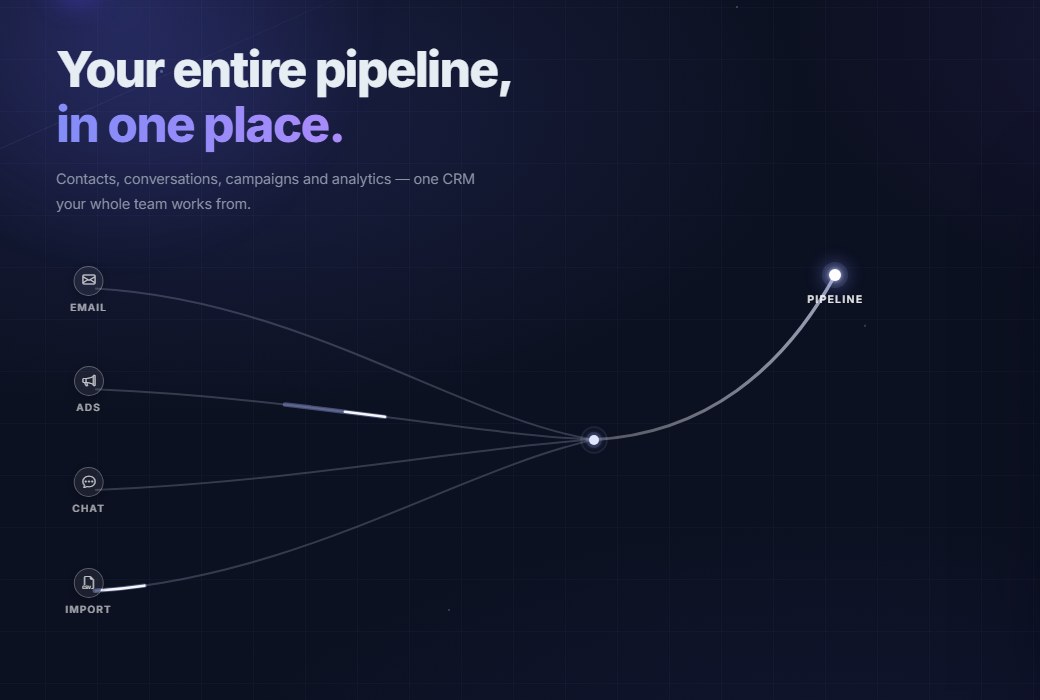 Sales
SalesA CRM built for lead data at scale
Lead lists in any spreadsheet layout imported without manual reformatting.
Read the case study
How the work runs
See the full processBusiness challenge
Start with a conversation, not a proposal
Tell us what is not working. If we are not the right people for it, we will say so.
Or call 020 3059 4506 · Mon–Sat, 9am–5.30pm